

Our Nation
Click on Book for Amazon
.jpg)
The church was established to serve the world with Christ-like love, not to rule the world. It is called to look like a corporate Jesus, dying on the cross for those who crucified him, not a religious version of Caesar. It is called to manifest the kingdom of the cross in contrast to the kingdom of the sword. Whenever the church has succeeded in gaining what most American evangelicals are now trying to get – political power – it has been disastrous both for the church and the culture. Whenever the church picks up the sword, it lays down the cross.
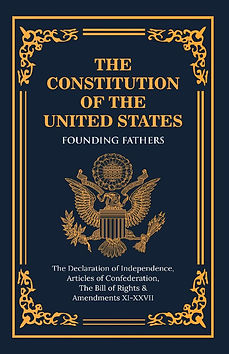
The Constitution of the United States is the supreme law of the United States of America. It superseded the Articles of Confederation, the nation's first constitution, in 1789. Originally comprising seven articles, it delineates the national frame and constraints of government. The Constitution's first three articles embody the doctrine of the separation of powers.

In today’s contentious political climate, understanding religion’s role in American government is more important than ever. Christian nationalists assert that our nation was founded on Judeo-Christian principles, and advocate an agenda based on this popular historical claim. But is this belief true? The Founding Myth answers the question once and for all.
Boyd, Gregory A. (2009-05-17T23:58:59.000). The Myth of a Christian Nation: How the Quest for Political Power Is Destroying the Church. Zondervan. Kindle Edition.
Introduction
LIKE MANY EVANGELICAL PASTORS IN THE MONTHS BEFORE THE 2004 election, I felt pressure from a number of right-wing political and religious sources, as well as from some people in my own congregation, to “shepherd my flock” into voting for “the right candidate” and “the right position.” Among other things, I was asked to hand out leaflets, to draw attention to various political events, and to have our church members sign petitions, make pledges, and so on. Increasingly, some in our church grew irate because of my refusal (supported by the church board) to have the church participate in these activities. In April of 2004, as the religious buzz was escalating, I felt it necessary to preach a series of sermons that would provide a biblical explanation for why our church should not join the rising chorus of right-wing political activity. I also decided this would be a good opportunity to expose the danger of associating the Christian faith too closely with any political point of view, whether conservative or liberal. I had touched on this topic several times in the past but never as deeply, clearly, and persistently. The series was entitled “The Cross and the Sword,” and it forms the foundation for this book.
Fathers, Founding. The Constitution of the United States of America: The Declaration of Independence, The Bill of Rights (p. 5). Global Publishers. Kindle Edition.
Introduction
IN CONGRESS, July 4, 1776 The unanimous Declaration of the thirteen United States of America When in the Course of human events, it becomes necessary for one people to dissolve the political bands which have connected them with another, and to assume, among the Powers of the earth, the separate and equal station to which the Laws of Nature and of Nature’s God entitle them, a decent respect to the opinions of mankind requires that they should declare the causes which impel them to the separation. We hold these truths to be self-evident, that all men are created equal, that they are endowed by their Creator with certain unalienable Rights, that among these are Life, Liberty, and the pursuit of Happiness.—That to secure these rights, Governments are instituted among Men, deriving their just powers from the consent of the governed,—That whenever any Form of Government becomes destructive of these ends, it is the Right of the People to alter or to abolish it, and to institute new Government, laying its foundation on such principles and organizing its powers in such form, as to them shall seem most likely to effect their Safety and Happiness. Prudence, indeed, will dictate that Governments long established should not be changed for light and transient causes; and accordingly all experience hath shown, that mankind are more disposed to suffer, while evils are sufferable, than to right themselves by abolishing the forms to which they are accustomed.
Seidel, Andrew L (2019-05-13T23:58:59.000). The Founding Myth: Why Christian Nationalism Is Un-American . Union Square & Co.. Kindle Edition.
Introduction
Andrew Seidel’s The Founding Myth: Why Christian Nationalism Is Un-American could hardly arrive at a more propitious moment, as a nation nation based upon the world’s first secular Constitution—a document that never mentions any god and derives its authority from “We the People”—must cope on a daily basis with an administration in thrall to what is best described as Christian nationalism. President Donald J. Trump never displayed any intense interest in religion of any kind in his public persona before he began running for the nation’s highest office. But he owes his election to far-right Christian nationalists, whom he has rewarded with an unprecedented number of cabinet appointments and judgeships galore (the latter certain to outlast Trump). Who will ever forget former attorney general Jeff Sessions’s biblical rationalization for Trump’s policy of separating migrant children from their parents? Sessions turned to a passage from Paul’s Epistle to the Romans, in which Christianity’s first great proselytizer admonished every soul to be “subject to the governing authorities; because there is no authority except that which God has established.” (A federal judge thought otherwise, however, and ordered the government to reunite the families—thereby deciding that the Constitution, not a first-century evangelist, is a higher authority on the making of public policy.)