

Christianity Page 2
Click on Book for Amazon
Matthew 24:23 “Then if anyone says to you, ‘Look, here is the Christ!’ or ‘There!’ do not believe it. 24 For false christs and false prophets will rise and show great signs and wonders to deceive, if possible, even the elect. 25 See, I have told you beforehand.

American evangelical Christianity has lost its way. While the witness of the church before a watching world is diminished beyond recognition, congregations are torn apart over Donald Trump, Christian nationalism, racial injustice, sexual predation, disgraced leaders, and covered-up scandals. Left behind are millions of believers who counted on the church to be a place of belonging and hope.

In Testimony, Ward tells the engaging story of his upbringing in, and eventual break from, an influential evangelical church in the 1980s and 1990s. Ward sheds light on the evangelical movement's troubling political and cultural dimensions, tracing the ways in which the Jesus People movement was seduced by materialism and other factors to become politically captive rather than prophetic
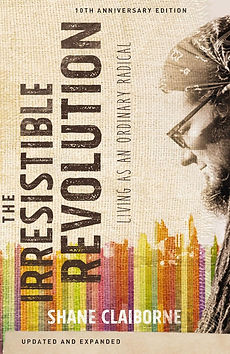
In The Irresistible Revolution, Shane describes an authentic faith rooted in belief, action, and love, inviting us into a movement of the Spirit that begins inside each of us and extends into a broken world. He asks and answers key questions like:
-
How can I sustain my faith and combat burnout?
-
Should Christians be involved in politics?
-
How does God want me to spend my life?
Moore, Russell D.. Losing Our Religion: An Altar Call for Evangelical America (p. 4). Penguin Publishing Group. Kindle Edition.
Introduction
If we wanted to find Jesus, we would have to lose our religion. That’s what the preacher said. In fact, he said it every week, every Sunday morning and every Sunday night, and then in the fall and the spring, he would bring in a guest evangelist to tell us the same thing. Religion, he said, gave the wrong answers because it asked the wrong questions. Religion asked, “Am I a church member?” or “Am I an American?” Religion asked, “Am I a moral person?” or “Do my good deeds outweigh my bad?” Religion asked, “Can I assent to the fact that the Bible is true?” or “Can I recite a creed or a catechism?” Those were the wrong questions, and religion gave the wrong answers. The ultimate questions were deeper, more personal: “Do you know you’re a sinner?” and “Do you trust the crucified and risen Jesus to atone for that sin?” and “Will you commit your life to taking up your cross and following him?” For those questions, they would assert, religion would not do, only a relationship, a personal, living faith—not your church’s faith, not your country’s faith, not your family’s faith, but yours. If we were to see the kingdom of God, religion couldn’t get us there, they said. We must be born again. Some people call it an altar call. Some call it a “Come to Jesus” meeting. We called it an “invitation.” Though we were low-church Mississippi Baptists, who thought we didn’t have any ritual or formality, this was part of our liturgy. Every week, at the end of the service, the gospel would be repeated—about how God so loved the world that he gave his only Son, that whoever believed in him would not perish but have everlasting life.
Ward, Jon. Testimony: Inside the Evangelical Movement That Failed a Generation (p. 2). Baker Publishing Group. Kindle Edition.
Introduction
What is it, that spark that makes our lives worth living? Amid the exhaustion and boredom, the frustration and sadness, the grief and heartbreak, there is something that keeps us going. It’s a small and quiet sound. I often hear it, or feel it, in the early morning hours. But then it appears in the midst of a lazy summer afternoon, or in an autumn sunset, or in the car on a bleak midwinter Monday morning when I’ve just dropped the kids off at school and life feels pointless. It’s a sensation in the chest sometimes, a faint burning or warm feeling. Other times it’s just a serenity. And sometimes it’s a small whisper. It’s too quiet for me to make out any words, but that doesn’t matter. I listen attentively. This is an elusive thing. It runs away the moment I try to put it into words. Sometimes I sit down and try anyway. Unless I attempt this right away, the spark is too ineffable to capture later. The feeling I get from this small flame is that there is a point and a purpose to all this, to my life, to what is happening around me in this big, tragic, beautiful world. It is the voice of God. I was trained to hear it when I was a child, and this was a great gift.
Claiborne, Shane. The Irresistible Revolution, Updated and Expanded: Living as an Ordinary Radical (p. 18). Zondervan. Kindle Edition.
Introduction
While the voices of blockbuster movies and pop culture cry out for a life outside the matrix of numb efficiency, Christianity often has offered little to the world, other than the hope that things will be better in heaven. The Scriptures say that the entire creation groans for liberation, and the echoes of that groaning can be heard in everything from hip hop to Hollywood. There is a pervasive sense that things are not right in the world, and the gentle suggestion that maybe they don’t have to stay this way. The headlines tell stories of war and terror, sex scandals, corporate greed, prison corruption, the AIDS pandemic, police brutality, and the desperate poverty of our one billion hungry neighbors. Global initiatives like Live 8 and the ONE Campaign have gathered eclectic groups of celebrities and pop stars under slogans like “Make poverty history.” But most Christian artists and preachers have remained strangely distant from human suffering, offering the world eternal assurance over prophetic imagination. Perhaps it should not surprise us that Jesus says that if the Christians remain silent, then the rocks will cry out . . . or the rock stars, I guess. Meanwhile, many of us find ourselves estranged from the narrow issues that define conservatives and from the shallow spirituality that marks liberals. We are thirsty for social justice and peace but have a hard time finding a faith community that is consistently pro-life or that recognizes that there are “moral issues” other than homosexuality and abortion, moral issues like war and poverty. So some folks just end up trying to save individual souls from their sins, and others end up trying to save the world from “the system.”.