

Antisemitism
Click on Book for Amazon
IHRA Definition
(Link to IHRA Website)
In 2016, the International Holocaust Remembrance Alliance, an intergovernmental organization, adopted a Working Definition of Antisemitism to guide its work and educate and sensitize others to the need to confront antisemitism. Since its adoption, the Museum has encouraged support for the definition.
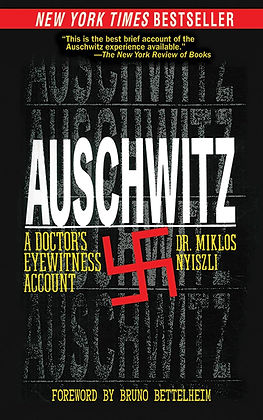
When the Nazis invaded Hungary in 1944, they sent virtually the entire Jewish population to Auschwitz. A Jew and a medical doctor, Dr. Miklos Nyiszli was spared from death for a grimmer fate: to perform “scientific research” on his fellow inmates under the supervision of the infamous “Angel of Death”: Dr. Josef Mengele. Nyiszli was named Mengele’s personal research pathologist. Miraculously, he survived to give this terrifying and sobering account.

DEBUNKING HOLOCAUST DENIAL THEORIES: Two Non-Jews Affirm the Historicity of the Nazi Genocide, by independent researchers and filmmakers James Morcan & Lance Morcan with a foreword by Holocaust survivor Hetty E. Verolme (author of The Children's House of Belsen), aims to end the denial once and for all by tackling the bizarre phenomenon head-on.

This is a unique, eye-witness account of everyday life right at the heart of the Nazi extermination machine.
Slomo Venezia was born into a poor Jewish-Italian community living in Thessaloniki, Greece. At first, the occupying Italians protected his family; but when the Germans invaded, the Venezias were deported to Auschwitz. His mother and sisters disappeared on arrival, and he learned, at first with disbelief, that they had almost certainly been gassed.
Nyiszli, Miklós. Auschwitz: A Doctor's Eyewitness Account (p. 18). Arcade. Kindle Edition.
Introduction
IT IS NOW MORE THAN SIXTY YEARS after the almost unimaginable events this book describes, and despite all efforts to make sure that the twelve incredible years of Hitler’s sway will never be forgotten, the fact remains that few of those who experienced the Nazi concentration camps are alive to bear witness. Inevitably and inexorably, history reduces the personal to the impersonal, subsumes the individual into the collective, renders the immediate remote. Monuments and museums, however eloquent, can never truly or fully convey the experience itself. That is why Dr. Miklos Nyiszli’s book remains so important some six decades after it was written, more than fifty years after it first appeared in Jean-Paul Sartre’s monthly review, Les Temps Modernes. One of the earliest books published on the subject—at a time when many preferred not to know what really went on day to day in the death camps—Auschwitz, for all the moral ambiguity of its author’s stance (which is duly noted by Bruno Bettelheim in his eloquent foreword), remains, as the New York Review of Books noted in a roundup of several books on the subject, “the best brief account of the Auschwitz experience available to a reader.”
Morcan, James; Morcan, Lance (2016-04-27T23:58:59.000). DEBUNKING HOLOCAUST DENIAL THEORIES: Two Non-Jews Affirm the Historicity of the Nazi Genocide .
Sterling Gate Books. Kindle Edition.
Foreword
This book has been written for those who believe the Holocaust is a fairy tale. It has been excellently researched by authors James & Lance Morcan, and they have proven beyond any doubt that the Holocaust did occur. Those who deny the Holocaust are not only ill informed, but their resistance to accepting a well establish fact comes from a deep-seated hatred of the Jewish people. In other words they are anti-Semites. Beyond a shadow of a doubt, the Nazis committed this heinous crime and the German people – who in the main were aware of the atrocities but kept quiet about them – are therefore guilty by association. SIX MILLION Jewish people were murdered in a manner which can scarcely be imagined except in the evil minds of the Nazis who set about bringing to fruition ‘The Final Solution’ – which they very nearly achieved. In total, they murdered and slaughtered 11,000,000 innocent people without mercy, and this figure does not include deaths resulting from the battles of war. As a Holocaust survivor I can speak of it as I did experience the terrible conditions for fifteen long months in Bergen-Belsen concentration camp. I vividly recall the hours standing for roll call during snowfalls, heavy rains, heatwaves and storms. We could not sit on the ground as we would lose our food rations for two days if we did. They counted us, but the SS always concluded two or three were missing, even though this was never the case as there was no way anybody could ever escape the camp with the watch towers everywhere and the SS men constantly on patrol with their dogs. They often forced us to stand for three or four hours, and sometimes up to nine hours, during roll call. Young and old were meted out this mental and physical cruelty.
Venezia, Inside the Gas Chambers: Eight Months in the Sonderkommando of Auschwitz. Polity Press. Kindle Edition.
Foreword
Shlomo Venezia arrived in Auschwitz - Birkenau on April 11, 1944; I arrived there myself, from Drancy, four days later. Until September 9, 1943, we had lived – he in Greece, I in Nice – under Italian occupation, with the feeling of being, at least provisionally, safe from deportation. But, after the capitulation of Italy, the Nazi vise immediately tightened, both on those who lived in the Alpes-Maritimes and on those in the Greek archipelago. When I speak of the Shoah, I often refer to the deportation and extermination of the Jews of Greece, since what happened in that country illustrates perfectly the fierce tenacity with which the Nazis pursued the “Final Solution,” hunting down the Jews even in the smallest and most remote islands of the archipelago. So it was with particular interest that I read the story of Shlomo Venezia, a Jew, an Italian citizen, who speaks not only Greek but also Ladino, the dialect of the Jews of Salonika where he lived. His name, Venezia, refers to the time when his ancestors, in the years of wandering that followed the expulsion of the Jews from Spain in 1492, had traveled to Italy before moving on to Salonika, the “Jerusalem of the Balkans,” ninety percent of whose Jewish community was exterminated during the Second World War. I have read many accounts written by former deportees, and each time they take me back to life in the camp. But the story told by Shlomo Venezia is especially overwhelming because it is the only complete eye-witness account that we have from a survivor of the Sonderkommandos.